The Bell That Wasn’t There

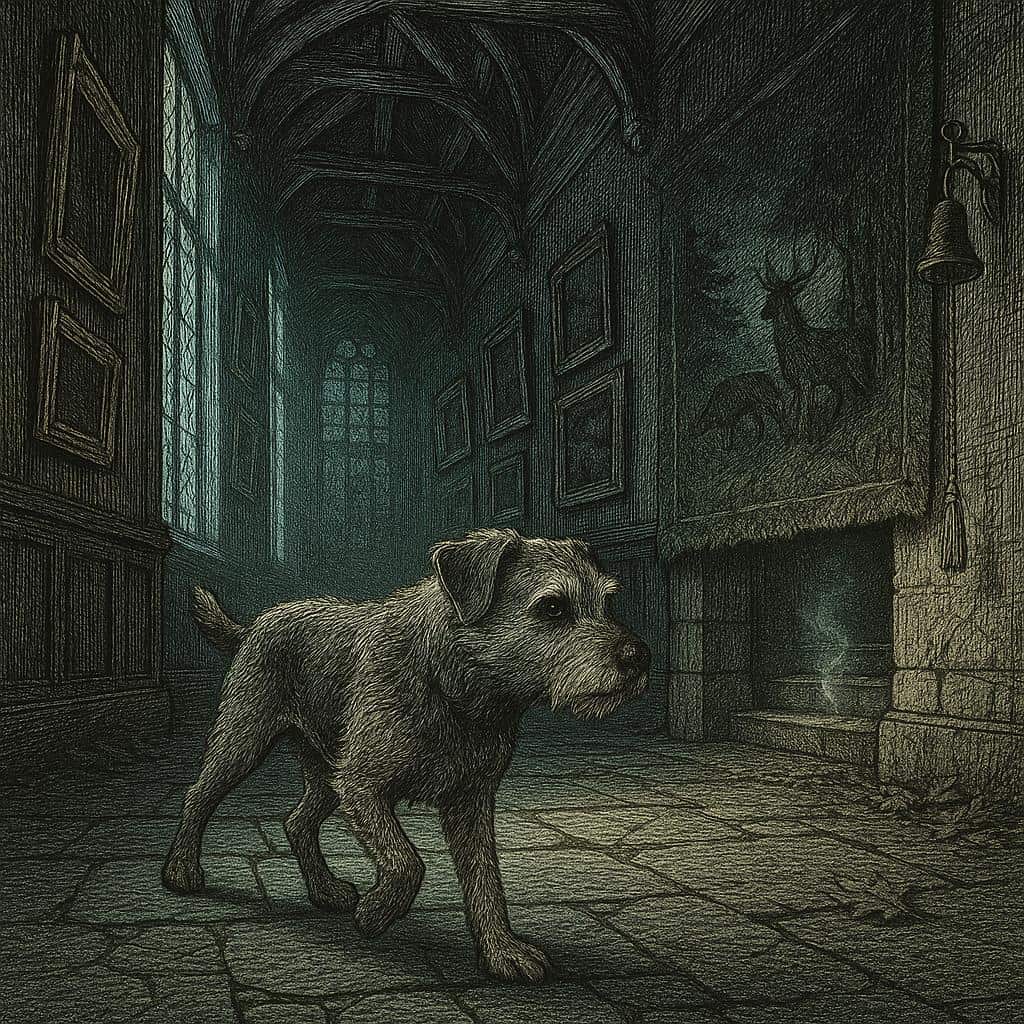
With moonlight pooling on cracked flagstones, Bramble, a fifteen-year-old Border Terrier, padded through the hushed castle. He ached in the hips, but curiosity glittered; he alone smelled the citrus-iron tang of old magic. In the great hall, portraits watched, whispering names he had buried. The tapestry of stags breathed like a sleeping thing, and he longed for the warm hands that were gone. From behind it sighed a hidden stair. Bramble pushed through, tail steady, heart brave. Far below, a bell chimed without a bell, and a familiar voice called his name. He answered, and something answered back.
The stair corkscrewed into damp hush, each step cupped in the middle by centuries of feet, pads, hooves. Bramble’s nails clicked, then softened as moss gave under him. The air grew cool and sweet with stone, and underneath that—bright as a peeled orange, sharp as a bitten lip—the citrus-iron of old magic thickened until it made his whiskers prickle. He paused once to breathe it in, letting it settle into the old maps of his head where smells lived forever and stitched themselves to faces and weather and the sound of boots on boards.
The bell chimed again, the note trembling in his ribs. It was not a sound so much as a shape pressing through him, a hollow cup ringing where nothing hung.
Bramble moved on. The stags on the tapestry behind him sighed back into thread, the old cloth settling as if it had never breathed at all. He went down until the castle’s heartbeat was all around him, and came to a low doorway, arched like a yawn.
The chamber beyond was round, the walls bulging like the inside of a bell. In the center, a shallow basin the size of a cartwheel sat carved from one piece of stone. It was dry, but the air above it quivered as if heat rose from it. Around the basin, the walls were scratched with crude lines: antlers, running dogs, hands with splayed fingers. Someone—many someones—had worried the stone with knife-tips or nails until these shapes lived there. Bramble drifted close, nose working. Here the magic was almost something he could taste, fizzing on his tongue and slicking the back of it with metal. He remembered the first time he’d smelled it, kneeling under a table as a child’s voice read softly and a storm stalked the windows. He had put his muzzle on a set of knees and received the absentminded pressure of fingers in his fur, and he housed that night down in him like a lit coal.
“Bramble,” said the voice again.
It was close, and it wasn’t. It came from the place above the empty bowl where the air shivered. The word wore the lift and fall of Rowan’s mouth, her way of making his name stretch and warm. He had heard it as a whistle on the moor, as a murmur under covers, as a shout through trees. He had heard it turn into laugh, into sob. He had watched that voice thin and vanish and had slept on her sweater for a year, chewing the cuffs to eat the smell of her as it faded.
He lifted his head and gave one low arf. It left him and struck the roundness of the room and came back altered, deeper, a dog he knew and didn’t know answering him from inside the stone.
“Bramble,” the air said, more urgent. Then, softer, full of apology: “Come on then.”
He put his front paws on the edge of the basin. It was smooth in the way that only thousands of hands make stone smooth. He peered into it. There was only a skin of shadow. He could see his own snout inverted, the white hairs at his muzzle scattering the dark. The citrus-iron smell was so strong now it was almost a wind.
He touched the surface with the leathery tip of his nose.
It was not wet, not cold. It was like pushing into a soft door. Every hair along his spine lifted. The old ache in his hips lifted with them and stepped away. The bell sang, not a single note this time but a spill of them, a handful of bright things let fall.
He did not fall. He went forward the way a dog goes through a flap, and the world changed.
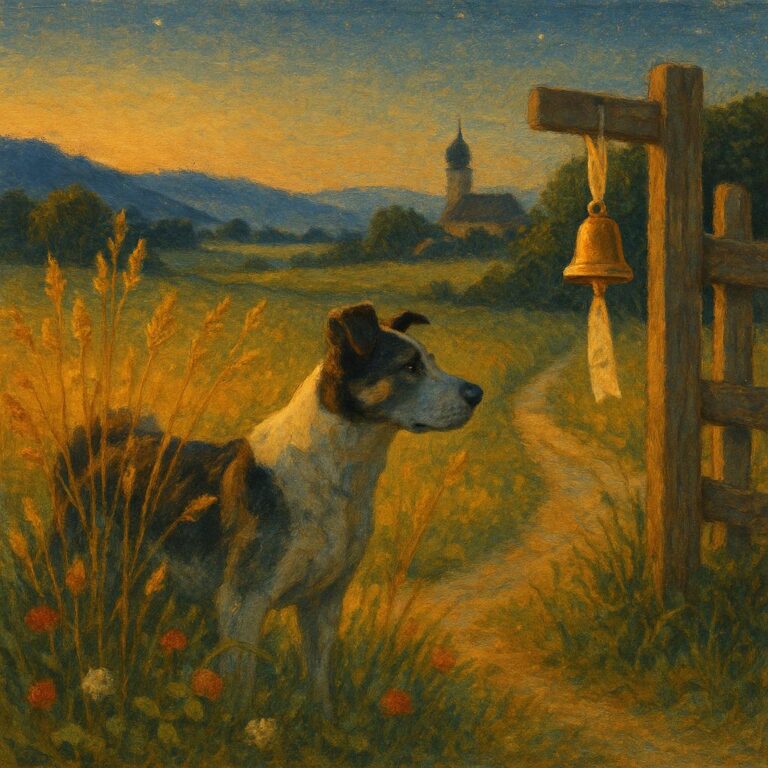
Grass under his feet, spring-thick and high enough to brush his belly. Bees. Warmth. The sky pinwheeled in his eyes and went still. The air here smelled like early pears and ink and soap and clean skin. He knew the run of it; he knew it better than he knew the castle. He knew the print of a laugh thrown across it before it arrived.
“Bram!”
He bounded. He did not think of bounding. He simply was motion, the engines of him firing the way they had when his paws were oversized and his ears hadn’t learned to be ears. His hips were not there to be noticed. The world narrowed to a shape running toward him, and then there were knees and hands and the squeak of a person not quite crying and not quite laughing, and his name was said into his ruff like a secret.
Rowan smelled the same as forever and also like something new, a thin sweetness he couldn’t ever find on the moor. Her hair had silver threaded through it now the way frost does, and the bones of her face pressed closer to the surface, but she was Rowan in the way that mattered; she was a string snugged into place from his chest to hers. He pushed his head under her chin and inhaled until his lungs hurt. She let him, her fingers kneading the places they had always known: the side of his neck, the hollow behind his shoulder. He tumbled back and looked at her and barked once. She wiped at her cheek and showed her teeth, the good kind of teeth.
“Good boy,” she said, and it was the phrase that opened all the doors.
Behind them, something moved. The stags from the tapestry had walked out of thread and into this meadow. They arranged themselves at a distance, heads up, breath pluming. Their antlers were centuries of forest. They watched as if they were waiting to escort something larger than both of them.
Rowan’s hand found the old patch of scar on his belly where the bramble had torn him when he was no taller than the thistles. “You found it,” she said. “Of course you did.”
He leaned hard into her, catching her with the shoulder he had used to open doors he wasn’t supposed to. He saw now, tilted behind her like a reflection laid over the meadow, the round chamber and the empty stone bowl. He saw himself like a curled comma at its rim and then as he was, breath big and clean. He flicked his ears in mild confusion and abandoned it. This world held bees, and he chuffed at one and made her laugh again.
“I didn’t want to go without you,” she said. Her thumb traced the bone at the top of his head, the place every hand loves. “I waited as long as I could. Do you want to come with? Or would you like to go back and mind the house like you always do?”
He stood very still, thinking the way dogs think, which is to say not in words but in pictures that smell. He saw the hall with the portraits who whispered and named dead men. He saw the kitchen stone where a shaft of sun warmed him in the short afternoons. He saw the stable with its empty stalls and the pile of old coats he burrowed under, finding the ghosts of fox and hay. He saw the girl who was gone and the woman who had been, and the space she had left that he tried to fill by making his circle larger, patrolling, lying with his chin on the threshold until his nose was damp with the night.
He pressed his face into Rowan’s palm and made a small noise from the back of his throat. It meant yes in all directions.
“Alright then,” she said, relief and love making her voice a soft rasp. “Alright.”
The stags stepped forward and the meadow folded itself into a path no human had made. Rowan stood and the light came with her, catching on every seed head and cobweb so that the air glittered in a quiet way. She clicked her tongue gently, a sound he had followed through bracken and broom and once through a pack of laughing boys who had drunk too much and waved their arms. He followed now. He did not look back at the bowl or the chamber or the idea of himself curled there, because that was not what the moment was for.
They went. The bell notes came not from behind but ahead, strung along the path like things to be collected. Bramble trotted at her knee, then ranged ahead, then returned to touch her, then looped circles around the stags’ long legs, which did not mind him. His breath was a good pressure in his chest. His paws were his, all the way to the toes.
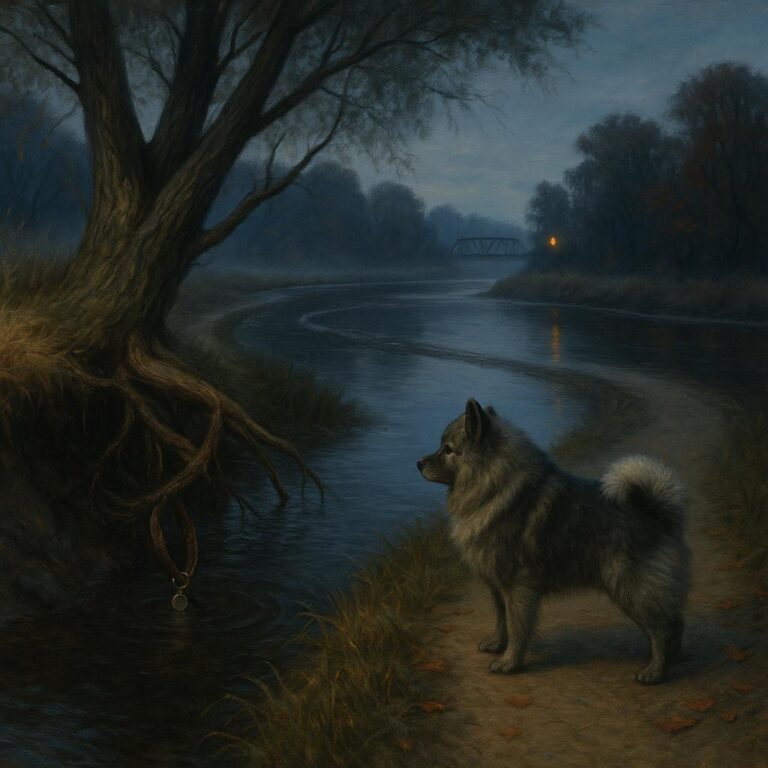
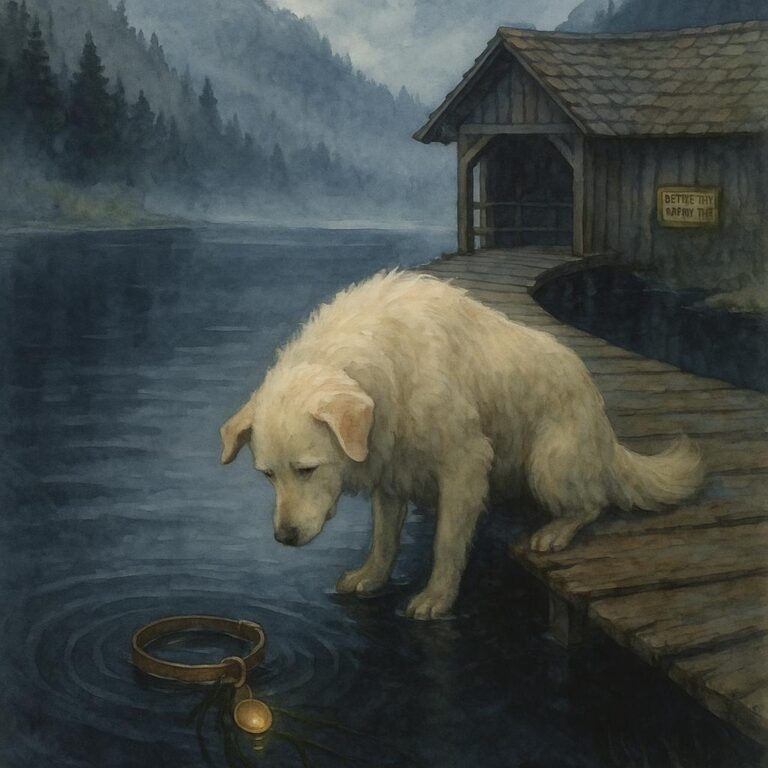
They came to a place where the light gathered the way water does, becoming a slow river of it. The stags halted and lowered their heads as if to drink. Rowan knelt and held his collar, the old leather grown milky at the edges, the brass tag rubbed smooth. She unbuckled it, not like taking it off but like untying a ribbon on a parcel. The collar fell into her lap and somehow made the sound of a bell when it struck her knee.
“Time,” she said.
He heard his name in the word.
He stepped forward. The river of light gave, welcomed, bore. For one skipping heartbeat, Bramble felt the castle around him again: the crack in the flagstones where his nail sometimes caught, the draft that came from the servants’ door, the hush of mice like rain in the walls. He felt his own absence settle into those things the way a warm body leaves a dent in a bed.
Up above, portraits stilled their whispering and regarded one another. The tapestry of stags lay obedient and flat. In the great hall, the air lost the taste of orange and iron and picked up again the simpler smells: old wood, polish, the phantom of bread.
In the round chamber, the surface of the empty basin gleamed as if someone had wiped it carefully with a sleeve. A little white hair lay on its rim. If you had stood there and listened very hard, you might have heard, under all the stone’s quiet, the final, satisfied settling of a bell that had finished its ringing.
Bramble trotted into the light and then, because he had always done it and it had always pleased her, he broke into a run. He ran with his head up and his ears flying foolishly, and Rowan laughed and ran too, and the stags’ hooves made no sound at all. When they were gone, the path cut across the meadow like a thought you could almost remember, then it went the way of the stags and the breath of the world filled in where it had been.
Night lay over the castle when the moon moved. It shone on the cracked flagstones and made coins of light. Somewhere, not above or below but at the exact place where you keep the names you don’t say out loud, a dog slept with his chin on a pair of hands, and the hands were warm. The house exhaled. It did not forget. It did not grieve. It kept watch, the way a good house does, the way a good dog taught it.