8 Ways to Keep Your Senior Dog Safe on Stairs, Slippery Floors, and Furniture

As your dog gets older, everyday spots in your home can become harder to handle. Stairs, smooth floors, and tall furniture that once felt easy can now cause slips, stumbles, or hesitation.
Many senior dogs also lose some strength, balance, or eyesight, which makes falls more likely.
You can keep your senior dog safer by adding grip to slick floors, limiting access to stairs, and giving your dog an easy way onto the furniture they love. Small changes like these can help your dog move around with more confidence.
Some of them take just a few minutes to set up, and the steps and gates suggested for older dogs can make a real difference at home.
The ideas ahead cover simple fixes for floors, stairs, and furniture, along with ways to make daily routines easier on your dog’s body. You will also learn how mobility changes with age and when it makes sense to talk with your vet.
1) Add non-slip runners to the routes your dog uses most
Smooth floors can be tough on an older dog. Weak muscles and sore joints make it harder to stay steady on tile, wood, or laminate. A good runner gives your dog something to grip.
Start by watching where your dog walks each day. Think about the path from the bed to the water bowl, to the back door, and to the spot where your family hangs out.
Lay secure, non-slip runners along the routes your dog uses most.
Pick runners with a firm backing so they stay put. A rug that slides is more of a hazard than bare floor. Press down on each corner to check that it lies flat, and tape or secure any edges that curl up.
Try to keep the routes short and easy. A short, non-slip route from your dog’s crate or bed to key spots can help your dog feel more sure on their feet.
2) Secure rugs and mats with nonslip backing
Loose rugs can slide under your senior dog’s paws. Older dogs often have weaker muscles and sore joints, so even a small slip can be hard on their bodies.
Start by checking every rug and mat in the rooms your dog uses most. Give each one a push with your foot. If it moves, it needs a fix.
Nonslip backing or rug pads can help hold rugs in place. You can also use rubber-backed mats or carpet tape on floors where it is safe to do so.
Skip small throw rugs at the top or bottom of stairs, since loose rugs near stairs are a known fall risk for older adults, and the same idea applies to your dog.
Rugs can also help your dog get around. Placing nonslip runners along hallways gives your dog a grippy path across slick floors.
Check the backing now and then. It can wear down over time, and curled edges can trip a dog who lifts their feet less than they used to.
3) Keep your dog’s nails trimmed and paw fur tidy for better traction
Long nails can make it hard for your senior dog to grip the floor. When nails touch the ground, they push the toes up and back. This can make your dog slip, especially on tile, wood, or the stairs.
A good rule is to check the nails every few weeks. If you hear a clicking sound when your dog walks on a hard floor, the nails are likely too long. Trim a little at a time and avoid the pink part inside the nail, called the quick.
Older dogs may not like having their paws handled. Go slowly, give treats, and take breaks if your dog seems tired or sore. If you feel unsure, a groomer or vet can help.
Fur between the paw pads matters too. Long hair there can cover the pads and make your dog slide. Use blunt-tip scissors or a small pet clipper to trim the fur level with the pads.
Keep your dog still and calm while you work. Hold the paw gently, since senior dogs often have stiff joints. If trimming feels risky, ask a groomer to do it for you.
4) Block stair access when your dog is home alone
Your senior dog may not move as steadily as they once did. When you’re out, nobody is there to guide them or catch a slip on the stairs. That makes an unsupervised staircase a real risk.
The simplest fix is a sturdy gate. Experts suggest using one to block access when stairs are unsafe. Pick one that doesn’t tip over and has no gaps your dog could squeeze through.
Set up the space before you leave. Put your dog’s bed, water, and a spot to relax on the same floor, so they have no reason to try the stairs. Make sure they can reach the door to go outside, if that’s part of your routine.
Another guide for older dogs also lists stairs among the dangerous areas to block off.
Let your dog get used to the gate while you’re home. That way it feels normal, not scary.
5) Use a sturdy ramp or pet stairs for furniture access
Many senior dogs still love to curl up on the couch or your bed. The trouble is that jumping up and hopping down puts strain on stiff joints. A ramp or set of pet stairs gives your dog an easier way up.
Pick one that feels solid. It should not wobble or slide when your dog steps on it. A non-slip surface helps your dog keep their footing, and a gentle slope is easier on sore legs than a steep one.
Steps can help dogs get on and off furniture, and ramps work too, as this guide on home changes for arthritic dogs explains. Which one is best depends on your dog. Small dogs often do well with stairs, while dogs with very stiff legs may find a ramp simpler.
Go slowly when you introduce it. Place a treat on each step or along the ramp and let your dog sniff it first. Praise every try, even small ones.
Keep the ramp or stairs in the same spot so your dog learns where to find it. Check it now and then for loose parts or worn grip.
6) Add stair treads or carpet strips for grip
Older dogs often lose strength in their back legs. Bare wood or tile stairs can make each step feel risky for them.
Adding grip to your stairs can help your dog feel steadier. Stair treads and carpet strips both give paws something to hold onto. One guide on home safety suggests textured stair treads to lower the chance of slipping.
Choose treads that cover most of each step. That way, your dog’s paws land on a grippy spot every time, even if they step off center.
Press each tread down firmly and check that it stays put. A loose tread can slide or curl at the edge, which may cause a fall. If you use carpet strips, make sure the edges are not frayed.
Check them often and replace any that wear out. Go slowly the first few times your dog uses the new steps. Walk beside them and offer a treat at the top or bottom.
Some dogs need a little time to trust the new surface. If your dog still struggles, you can carry them or block off the stairs.
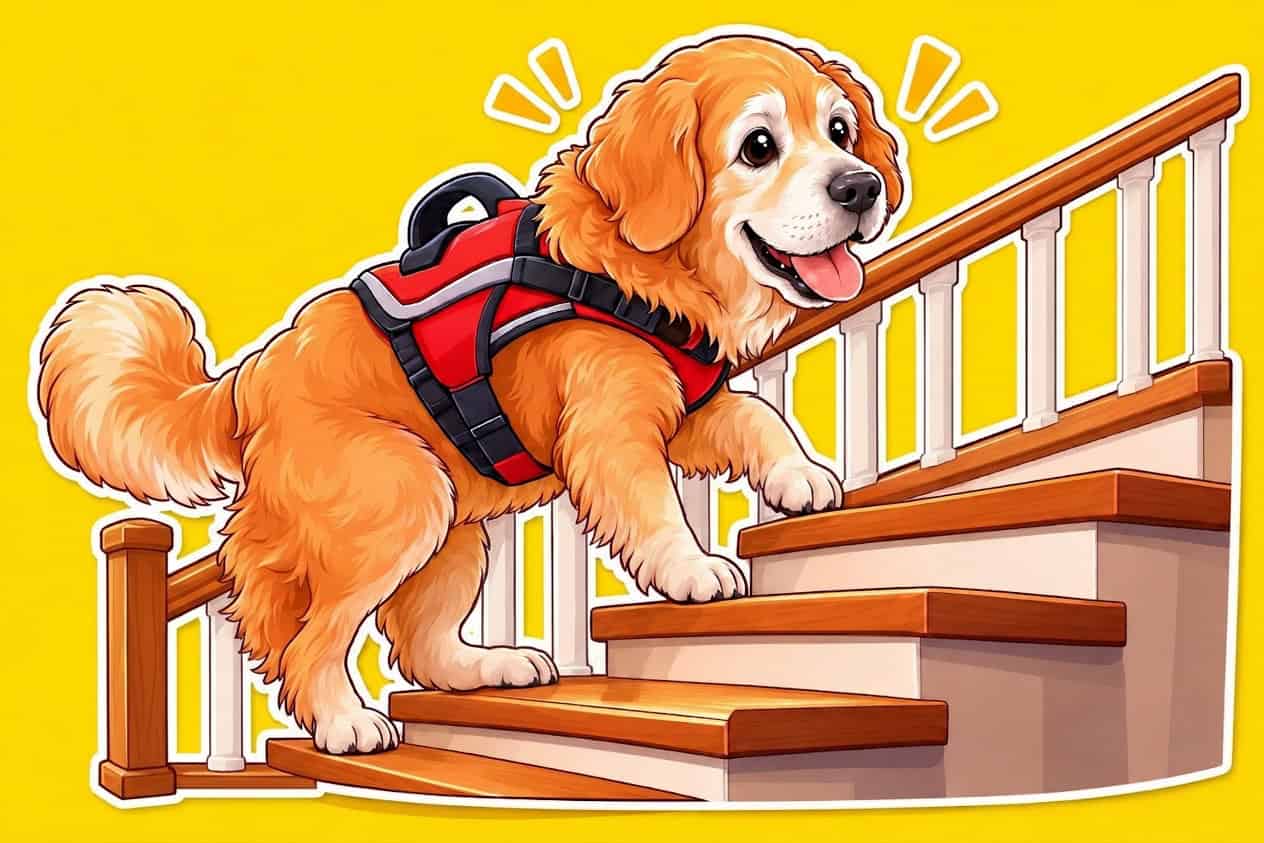
7) Help your dog on stairs with a properly fitted mobility harness
Stairs can be hard on an older dog. Sore joints and weak back legs make each step harder than it used to be. A mobility harness gives you a way to lend a hand.
Look for a harness with a handle. A harness with a handle can help support dogs as they move around your home. You can lift gently to take some weight off their legs on each step.
Fit matters a lot. A snug-fitting chest harness can help support your dog’s whole body as they move. It should not pinch, rub, or slide around.
Check the fit often. A harness may gradually become tighter as your dog ages and their body changes.
Go slowly and stay beside your dog on the stairs. Let them set the pace. If you are unsure which style suits your dog, your vet can help you pick one.
8) Place food, water, and bedding on one level
Stairs get harder for a senior dog as the years go by. Sore joints, weak legs, and poor eyesight can all make each trip up or down a risk.
Try setting up your dog’s daily spots on one floor. Put the food bowl, water bowl, and bed close together, and pick the level where your dog spends the most time. A bed on the main floor can cut down on repeated trips on the stairs.
Keep things in the same place from day to day. Older dogs that are losing their vision do better when furniture stays put and clutter is cleared away.
Wipe up spills near the water bowl right away. Wet floors are a slipping hazard for dogs and people alike.
If your dog needs a thick, supportive bed, choose one that is easy to step into. Then block off the stairs with a gate so your dog is not tempted to climb them alone.
Why Your Senior Dog Moves Differently Now
As dogs age, their joints stiffen, their eyesight dims, and their sense of balance gets less reliable. Moves that once felt easy, like climbing stairs or hopping on the couch, can start to feel risky or painful.
What Aging Does to Balance, Vision, and Joints
Your senior dog’s body changes in several ways at once. Muscles shrink, especially in the back legs, so your dog has less strength to steady each step. Joints may ache from arthritis, which makes bending and pushing off the floor harder.
Vision and hearing often fade too. A dog who can’t see the edge of a step well may misjudge it. Dim light makes this worse.
Here are common changes to watch for:
- Weaker hind legs: Back legs may wobble or slide out on smooth floors.
- Stiff joints: Your dog may be slow to rise after a nap.
- Cloudy eyes or poor night vision: Your dog may bump into furniture or miss a step.
- Worn paw pads and long nails: Less grip means more slipping.
Wood and tile floors are among the hardest surfaces for older dogs. Stairs need extra care as well, since open gaps between steps can be confusing and unsafe.
Hesitation Usually Means Pain, Not Stubbornness
When your old dog stops at the bottom of the stairs or won’t jump onto the sofa, it can look like stubbornness. More often, it’s your dog telling you something hurts or feels unsafe.
Dogs can’t say „my hip aches,“ so they show it through behavior. Some pause at the top of the stairs or slow down on a familiar walk. Others stop jumping on furniture they used to love.
Signs that point to pain or fear include:
- Stopping before stairs or furniture
- Limping or favoring one leg
- Licking a sore joint
- Sitting or lying down in an odd way
- Pulling back when you call them across a slick floor
Scolding or forcing your dog to move can make things worse. Instead, mention these changes to your vet. Pain can often be eased with treatment, and your dog will feel more confident again.
When to Call Your Vet
Some changes in your senior dog’s movement point to pain or illness that a vet can treat. A slip or fall can also cause hidden injuries, so what you do in the hours afterward matters.
Which Changes Are Worth a Vet Visit?
Slowing down is common in older dogs, but certain changes are worth a call to your vet. Pay attention if your dog starts to behave differently on the stairs, on the floor, or around furniture. Books on senior dog care note that a dog who pauses at stairs or slows down on a familiar walk may be telling you something hurts.
Book a vet visit if you notice:
- Hesitating or refusing stairs, or the couch or bed, when your dog used to jump up
- Limping, stiffness, or slipping that lasts more than a day or two
- Trouble standing up from a lying position
- Licking or chewing at a joint
- Whining, panting, or restlessness at night
- Little or no urine, or signs of illness, which need veterinary advice
Don’t wait for things to get worse. Early treatment, such as pain relief, often helps your dog stay comfortable and active longer.
What to Do After a Slip or Fall
Stay calm and keep your dog still at first. Check for yelping, limping, a hunched back, swelling, or a leg held up off the floor.
Gently feel along the legs and spine, and stop if your dog flinches or snaps.
Call your vet right away if your dog can’t stand, drags a leg, cries out, or seems weak or confused. Pale gums, heavy panting, or vomiting after a fall are also reasons to get help quickly.
Many vets suggest an exam even when your dog seems fine, because older dogs often hide pain. Don’t give human pain medicine, since many common ones are toxic to dogs.
If you need to move your dog, slide a firm board or a blanket under the body to keep the spine level.
Afterward, note where and how the fall happened. That tells you which spot in your home needs a rug, a gate, or a ramp.