Whistle in the Kudzu

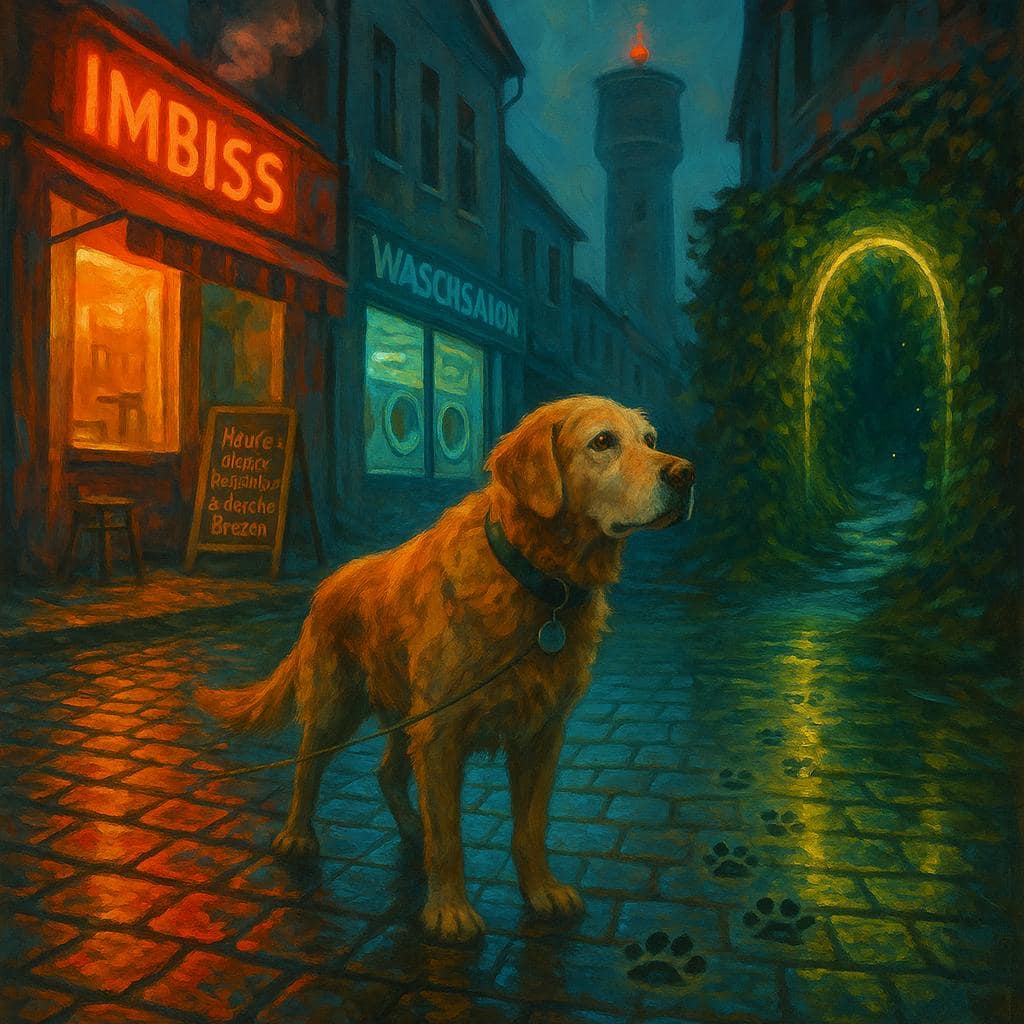
Glow from the diner sign puddles across Main while I, Duke, a Golden Retriever, fifteen years old, nose the night. The water tower hums like a hive; fireflies sketch a doorway in the kudzu by the laundromat. I smell rain, biscuits, and something impossible: my boy’s whistle from fifteen summers ago. The doorway brightens, showing a creek that shouldn’t be there, and pawprints the size of mine leading in, fresh and warm. I step forward, tail steady, when a low growl curls from inside and my tag yanks tight as if bitten.
The tag bites my throat. I freeze, chin high, listening to the growl build like thunder in a garage. The kudzu doorway breathes warm creek air—honeysuckle, river mud, tomato vines, my boy’s soap from the summer he tried to shave and nicked his lip. The growl is wrong and right at once. I know the shape of it. I know the breath between the notes. I know because it’s mine.
I press forward anyway, slow, easing my shoulder through glossy leaves. My tag scrapes metal on something I can’t see; the yank says no, but the scent says yes, and scent is the law. The laundromat hum fades; night thins. On the other side it is not night at all. It’s noon somewhere inside the plants, hot and full. Cicadas spin their rattles. Sunfish flash like loose coins. The creek that shouldn’t be there is exactly where it always was: where we went when the school bus emptied us out with a sigh, where the bottle caps got lost, where my boy learned to whistle for the first time without the penny under his tongue.
He’s there. He is not tall yet. His knees are green. He’s got a stick he hasn’t thrown and a mouth he’s trying not to smile with. He whistles and I twitch because it lands in me like a tossed treat, like a door opening. He blows the note that means Duke and the growl unwinds into a bark and across the shallows comes another me: my coat unbleached, shoulders round with strength I’ve been giving back cup by cup all these years, eyes like gold coins unscuffed.
He cuts me with a look. Hackles up, tail stiff. He is guarding. He is me when I learned the world had edges and a boy could fall off any one of them. I stand small—forehead low, ears sideways—tell him with my bones I am no threat. He tastes the air, and the words change from get out to what are you? We touch noses. The shock is the scent of myself at full bloom: wet tennis balls, chew-ropes, bike grease, bacon fat, the exact mold of my boy’s palm. My chest tightens with the joy of it and with greed I didn’t know I had: I want back the way my legs worked, I want back every run I cut short for stiffness. I want back my boy’s skinny hand and the whistle when he couldn’t find me in the kudzu because I was standing still to be a tree.
My boy sees me both ways at once. He blinks and rubs his face and says my name and I hear two voices stacked: the thin one from then and something lower he hasn’t grown into yet. He throws the stick without warning because he knows what that does to us. Both of me go; I go, the other me goes, and somehow we don’t touch. The water isn’t cold here. It slides over sore places and makes them guess again. My hips forget themselves and I leap longer than I’ve leapt in a year. My teeth close on wood and the taste is rich: river and sap and the faint salt of a hand I used to follow to bed.
We run until cicadas argue themselves hoarse. I shake and shower my boy with diamonds and he laughs the laugh he gave me when I chewed his library book and he forgave me before his mother did. The other me watches with a pride that I recognize later, out here, lying under tables while babies drop fries on my paws and strangers tell me I’m good. He knows he will be me. I know I was him.
I feel the doorway thinking. Fireflies are not doorways by themselves; they are hinges and they get tired. The nickel-bright line in the kudzu flickers. The hum of the water tower leaks back in around the edges. I smell rain again. I smell biscuits browning hard enough to snap. I smell the boy’s sweat turn to something he’ll carry decades and I smell something else too, new and near: coffee on a jacket, car heat, city air, loneliness pressed flat so it won’t wake the man wearing it.
The stick is in my mouth. The creek holds my legs as if to say one more. The tag tugs me back so hard I cough. The other me lifts his lip in warning—not at me, at the way things pull. He stands between my boy and the place where time gets thin, ears pinned like sails in a gust. I pick up what the creek came to give: the clean weight of that stick, the toothmarks I put in it long ago. I set my feet in the direction of Motion Light and Axle Grease and Biscuits, toward the world that hums.
The tag snags again, sharp as a caught thorn. I feel the no wrapped around my neck and I am suddenly, completely tired of it. I lower my head and push my ear through, twist the way I do when a fence says not today and ducks say oh yes. The collar holds to the kudzu with a small sound. It stays. The skin of my neck is naked. I am lighter than I have ever been, which is not an idea dogs use often, but I am. I step through leaves and out of noon into the diner’s late glare as easily as pulling free of a child’s gentle hand when he falls asleep and you need to get up for water.
Main Street is back to itself, wet in two places now: the rain that’s started and the creek water following me like a rumor. The Tower’s hum is all hive again; tires hiss far off. The neon sign spits from a letter that always does. The laundromat door is propped and warm-socks air breathes out a story about how all threads are strangers until they’re twisted together. I carry the stick past all that. I follow the smell of car seats and collars and a grown man’s worry. It’s at the back door.
The back door is open. The bulb above it makes a cone of night where the moths bump the idea of moon. He stands in the cone with a towel on his shoulder. He is my boy inside a man, and his shoes are wrong for creeks. His hair left its blond in the city or in some room he had to leave fast once. His hands know knives and steering wheels. He whistles because there is nothing else he can say to begin with. The note finds the ribs it knows in me. It hurts in a good way.
I drop the stick at his feet. It has traveled longer than most sticks do. It looks like nothing much: chewed and dark, lace of bark missing. He looks at it and then at me and then at the splash the stick made on his shoe leather and his throat works. He kneels. The towel slides off and makes a soft sound on concrete. He touches my bare neck like he’s checking for proof and finds only fur and pulse. His fingers run my ear the way you learn in second grade and never forget if it works; he finds the exact spot at the base which is mine. He says my name like it is a prayer he quit years ago and remembered under the hum of a tower.
“You found me,” he says, which is wrong in the way humans are wrong: they forget how often they are the ones shining. He smells like biscuits and rain and a hotel where he didn’t sleep. He smells like all the times he didn’t know what to do and did the small next thing anyway. He puts his forehead to mine the way my other boy—the boy from the creek—did once when he decided the math answer was going to beat him and then it didn’t.
I am wet and heavy. I am light and unhitched. I set my head on the square of his knee and it fits the old way. The kitchen’s fryers sigh. In the dining room, someone clinks a glass and someone else laughs a tired laugh. The rain takes a breath. He tells me I am good because he is human and has kept that word for years just for now. I know. I know all of it: the whistle, the door, the stick, the taste of his shirt when I pulled him out and the creek pulled back, the years between like a long hallway with carpets to nap on.
My eyes drop. The neon puddle under the sign shivers with the first fat drops. Fireflies switch off, polite. The corner of his jacket is under my cheek and his hand is steady on my side, counting. I can feel the count change to listening. The world narrows like a field you can see across at last. The hum of the tower folds into the creek’s song without a seam. The doorway is not in the kudzu anymore. It is wherever it needs to be when it is time.
It brightens one last time, not in the leaves but in the place behind my ribs where whistles land and stick. I do not have to push through anything now. There is no yank. I am already on the bank with bare knees and burrs and a boy who will always be exactly the size I can guard. I go the way a dog goes when called by everything that ever loved him: not because he’s told, but because that’s where his feet point.
I step into the water and it lifts what’s sore, and the stick is in someone else’s mouth who is also me, and the man’s hand stays on my side until it doesn’t have to. The rain comes, soft, making rings in both places. The whistle is a line through it all, and I follow it, tail steady.