Whisper on the Far Bank

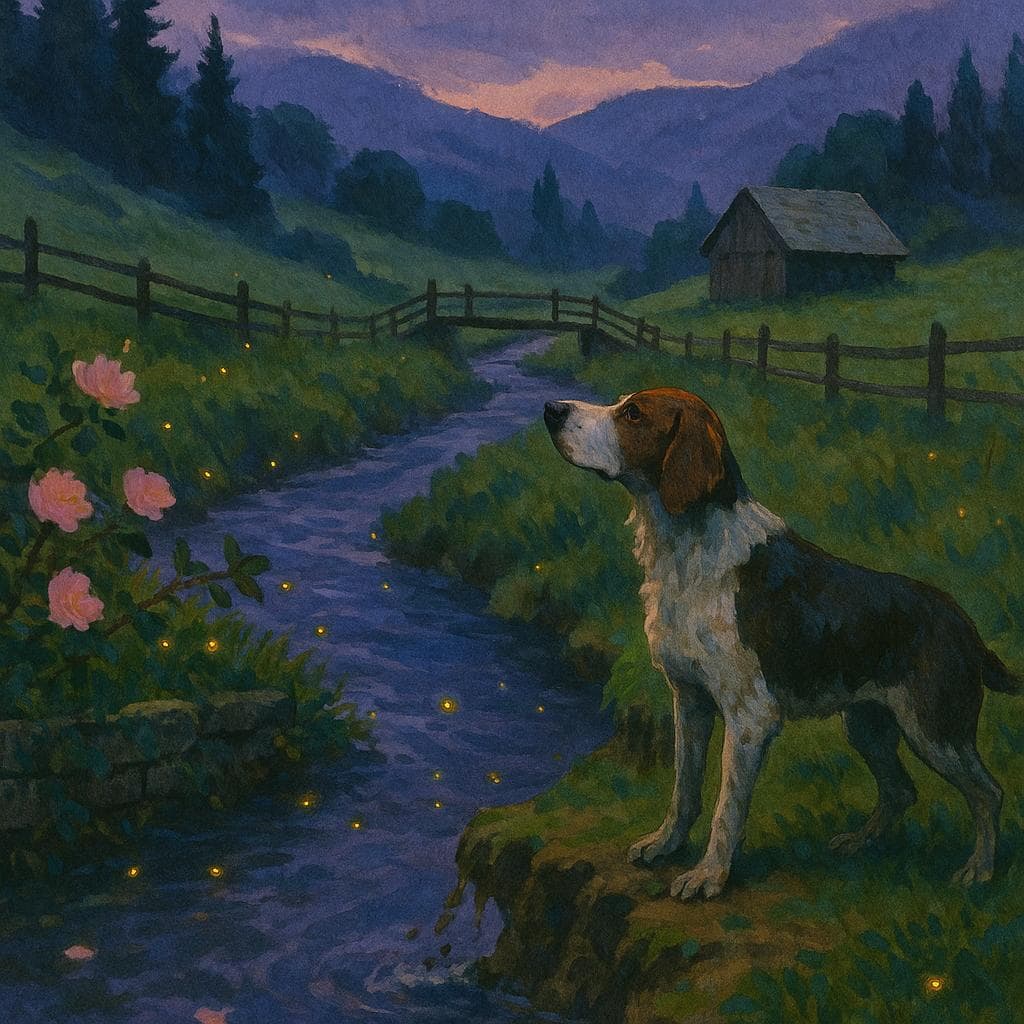
Beneath the violet hush of the valley, Brio, a thirteen-year-old Brittany, lifted his nose to the scent of rain and wild roses. The roses meant her, the memory his man wore like a second heartbeat. Brio’s hips ached, yet he trotted on, following the ribbon of perfume along the stream. Fireflies stitched gold between reeds; he felt the old pull of matchmaking, the work he loved. A shadow paused on the far bank, a woman-shaped stillness, and her whisper brushed his ears. He barked once, joyous, then the earth at the water’s edge shuddered and crumbled under his paws.
The world tilted; the stream rose up and swallowed the sky. Cold seized his belly and the old hips, and the rush of water took his bark and tumbled it into bubbles. Brio thrashed, not the bright, careless stroke of younger years but a stubborn plowing, nose lifting through the burn, ears slicked flat. The scent of roses held like a line in his mouth. He followed it as if it were a lead connected to the bones of the valley.
“Brio.” Not a whisper now but a breath with edges. The woman-shape on the far bank was moving along with him, knees dark with mud, palms open. The river turned him sideways; he struck a hidden branch, saw sparks, and went under. Water crowded his nose with iron and leaf rot. A hand had taught him once—always find the current’s gentler voice. He kicked toward the murmur he remembered by the birches, where the water broke itself thin over stones. His paws scuffed rock. The branch that had bruised him slid along his ribs, snagged his collar, tugged, then let him go.
He surfaced into rain. The valley exhaled. Fireflies stitched and erased themselves along the reeds. He coughed river and roses, blinked, and saw, through the glaze of water, her face bent over him on the near bank now—she’d crossed some way he couldn’t name, a narrow place perhaps, or the valley had simply moved her. She smelled of wet wool, old paper, and those roses, not a perfume but the ghost of it, as if it lived in her breath.
“Easy. I’ve got you,” she said, not to be heard over water but poured into it.
Fingers slid along the leather at his throat. Another set came a heartbeat later, familiar in the way a leash click is familiar, in the way Sunday morning was, with toast and the rustle of a newspaper. His man. His voice came down the slope in a torn shout. “Brio!”
Together their hands found the same place, skin against skin across the warm, panicked thrum of his pulse. Their grips made a loop. They hauled. Gravel gave way with the sucking sounds that had always made Brio impatient—he hated dirt on his feet—but now it was a music that held. He scrambled, nails scritching, shoulders burning, and they pulled, his ribs dragging over the lip, over moss and silt and into the bracken.
When his paws finally found honest ground, he shook. River flew in an arc over all three of them, diamonds lashing and then gone. The man laughed through the leftover fear; the woman blinked water and something else out of her eyes. Brio pressed his wet head against their knees in turn, the way he had when they all lived under one roof and someone dropped pasta, the way he had when storms pressed the house and no one could sleep.
“Hi,” she said to the man, and her mouth tried to be brave. It failed, and it was better for it. “I didn’t know you still walked this way.”
His man’s face rearranged itself, all the old doorways opening at once. He answered her name like a secret he hadn’t said out loud in years. Brio had known it, the way he knew the routes squirrels took and the trails rabbits abandoned—he’d known from that first thread of rose on a day when the wind held its breath. He had nudged his lead into his man’s hand, leaned his weight toward the valley, and stood like a stake until they’d come.
The rain thinned. The world was a held note. The woman’s hand smoothed the grizzle along Brio’s brow, thumb finding the place above his eye that always untied him. “You old matchmaker,” she murmured. He huffed, pleased and petulant, as if to say he’d done the heavy lifting.
The man’s palm rested at the base of Brio’s skull, warm, steady. He had his breath back, but he hadn’t moved his other hand from where it had landed on the woman’s wrist. None of them seemed in a hurry to break the circle.
“Do you—” the man began, and then the question untangled itself into a laugh. “Do you still carry rose gum in your pocket?” It was nothing and everything. She nodded, a shy tilt, and pulled a small foil from the wet hem of her jacket, holding it up like an improbable relic. The scent of manufactured sweetness didn’t reach Brio, not really; what reached him was memory. Kitchen tiles warmed by afternoon, her sandals tapping a rhythm, his own paws clicking along as he mapped the room between them.
They walked, because walking put the world right. The path along the stream had been chewed by water, but the valley always made a way for those who asked kindly. Brio limped a little and didn’t mind it. The woman gave him her sleeve to nose—he took the faint rose inked into the fibers and stored it. The man’s jacket brushed his ear; his pockets clicked with keys and the coin of habit.
Words followed them, catching on branches, falling back to touch the surface of the stream and ride along. They were not the fast, bright words of missing nothing, but slower, careful ones that knew the shape of loss and how to fit around it. Brio watched their feet and knew when their pace matched without anyone meaning it to.
At the footbridge, they paused. Years ago—seven? eight?—Brio had dragged a scarf from the laundry basket and carried it like a trophy, a white flag stained with the print of roses. The argument that followed had been soft and tired and full of rain. Tonight he nosed the place under the railing where he’d buried a bit of that scarf months back when the wind had told him she was coming home. The ground was damp and generous; he pawed once, twice, and the scrap gave itself up. He placed it on the boards between their shoes.
Her laugh came out of her with sunlight still in it. His man bent, touched the scarf like it could burn him. “You kept this?” he said to Brio, which was silly—Brio kept everything that mattered. He wagged, a slow metronome ticking through his spine.
By the time they reached the meadow, the valley was exhaling into night. The violet hush had deepened, and the fireflies were a net thrown wide. Brio eased down onto the damp grass with a sigh that belonged in an armchair. The man eased a blanket from his pack and shook it over him. The woman knelt, her knees pressing small moons into the earth, and slipped the blanket up under Brio’s chin. Her hand and the man’s hand found each other again there, above the rise and fall of Brio’s breath, and stayed.
Crickets took over the work of telling time. Somewhere upstream, the river practiced the same sentence over and over until it sounded like home. Brio let the world collapse to the shapes he knew: their feet near his paws, their voices braided, the rose and the familiar salt-and-wool of his man wrapping the edges. The ache in his hips eased into the ground, and his body remembered a thousand retrieves, a thousand simple jobs completed. This last one settled differently—a click, a latch thrown.
He blinked at the fireflies once, twice. He had found what was lost and put it where it belonged. The rest of it—the years, the work—could go slow. He was not in a hurry. He breathed in roses and rain and the clean animal comfort of being exactly where he was meant to be, and when he slept, he slept with his nose against their joined hands, his tail thumping once, satisfied, against the earth.