Whisper Beneath the Cloister

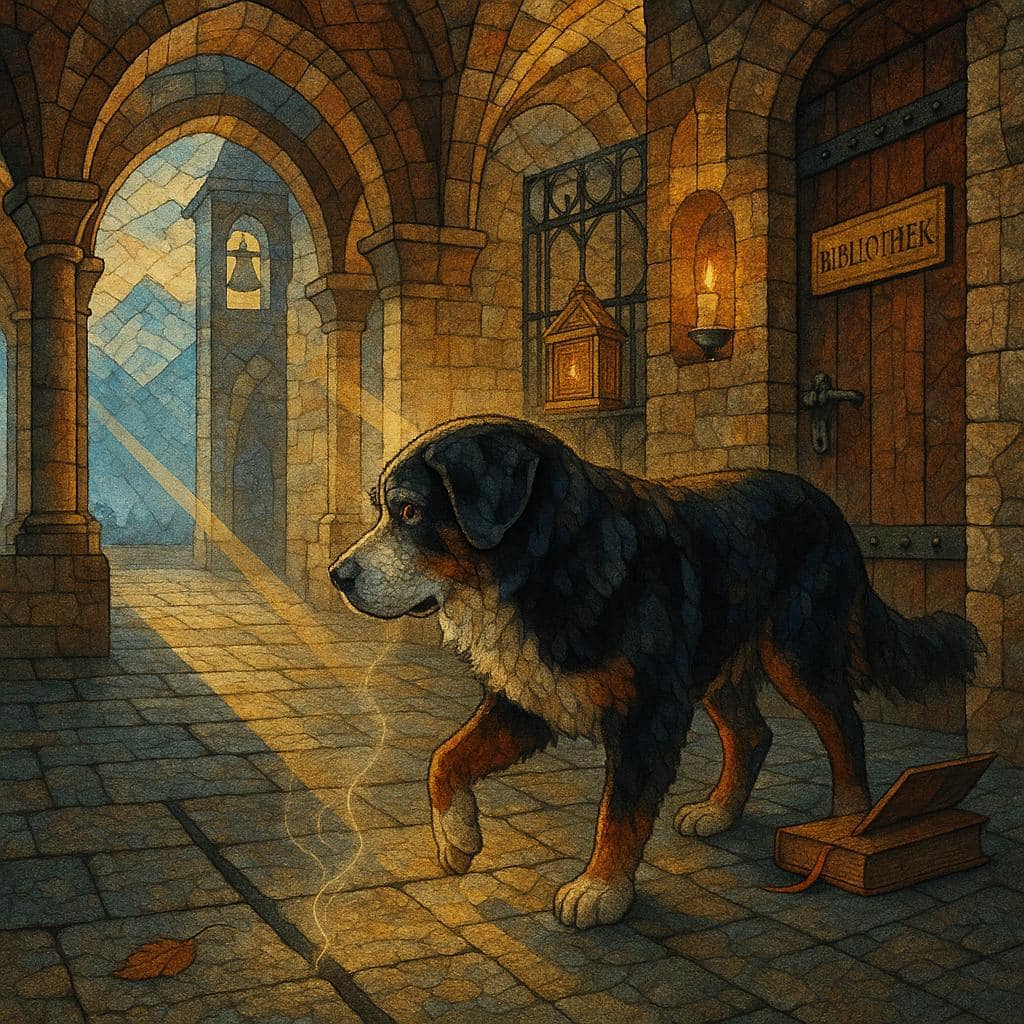
Morning light sifted through the cloister, and Bardo, a fourteen year old Bernese Mountain Dog, moved with solemn care along the worn stones. He knew every bell and footfall, yet today the monastery carried a question the monks could not name. He remembered snowfields and younger strength, and felt the hush where prayers gather when words fall short. Under the library, behind the reliquary, a draft rose from a seam in the floor. Bardo paused, ears pricked. A distant bell faltered. The seam widened with a breath like the earth waking, and something inside whispered his name.
He lowered his nose to the seam. The scent rising from it was old water and iron and the soft sour of roots, and underneath that a sweetness like beeswax from candles long gone out. He put one paw to the crack and felt the mortar crumble, granules catching in the fur between his toes. He pressed again, steady as a monk bowing, and the stone shifted, not much, just enough to free a breath that touched the whiskers at his jaw and said his name with a wet, hollow whisper only things underground can make.
He leaned his shoulder into the gap. Age had taught him to move with care, but the body remembers work, remembers snowbanks that gave way, remembers how to wedge and ease and not fight the weight of a thing. The slab yielded with a tired scrape. A cool exhale rolled over his face, tasting of clay. He did not wait for anyone to follow; he slid his bulk through the opening, ribs brushing stone, hindquarters bumping, and let the dark accept him.
The light went to a thin ribbon above. His paws found the steps before they found him, uneven, eaten by time. He took them slowly, paw after paw, nails ticking. The air below held a particular quiet, a bag on the heartbeat and a hush that did not belong to people. From somewhere to his right, water stitched a thin line. From above, the bell spoke again, stuttered, swallowed. The floor at the bottom leveled to packed earth, and Bardo stood in a long room that smelled of lime and dust and old wood. He blinked until shapes rose out of the murk: arches shouldering the ceiling, alcoves with shadows of shelves, a narrow altar with a stone cloth.
On the wall the monks kept paint that had turned to memory, saints and vines and a winter sky. A dog was there, big and black with rust at the chest, standing at the hem of a brown robe. The painter had given the dog eyes of attention. Bardo stood without moving, and in the sure weather of his old body something warm loosened.
A rope hung from a ceiling hole, frayed to rag where hands had not held it. It disappeared into the dark above, then back down again through a floor slit where some older arrangement worked its hidden labor. The rope smelled like the skin of trees in rain and like the hands of the men who had held it before the steeple was built, when the bell had lived closer to the ground. Bardo put his mouth to it the way he’d once taken the leather of a harness, careful of his old teeth. He tugged, gentle. Wood somewhere shifted. The bell above gave a low, surprised cough.
Footsteps and voices in the ribbon of light, then faces, one pale bisected by the line of the opening. „Bardo,“ someone breathed, not afraid to say it this time. The abbot’s shorn crown appeared, his hand to the stone. They saw the rope in Bardo’s mouth and the bristle of dust along his back. „Lads,“ the abbot said. „Boards. Levers. Mind the reliquary.“
They widened the gap with good sense and bad tools. Little stones rattled. Bardo laid the rope down and moved deeper, following the thread of water. The whisper that had said his name had more to it now—a little hiss and gurgle, frustrated, a throat that wanted to clear. The floor tilted and returned; the old passage bent. Dust lifted around him, turned by weak wind. He found the spring by its cold breath and by the trembling of fine hairs at his wrist. A low basin cut into stone collected a trickle the color of steel. Leaves and silt had turned to a plug at the lip. Beyond that, a tight seam led off like the slot a coin would travel.
He slipped a paw into the basin, pushed against the clog. It offered him the stubbornness of something that has been itself for too long. He backed his paw and dug into the edges where the flow tried to speak. Mud slicked his toes. He put both paws in, put his old weight into the work, claws moving like combs in wet hair. The plug tore. The seam drank. A little surge leaped into the basin and over its lip, warming as it met the air. The hiss rose, a relieved sound. Somewhere above and far away, the bell tried its voice again, less short of breath.
The men were with him then, lamplight finding walls that had not known it in generations. The abbot set the lamp on the altar as if it belonged there. One of the younger brothers—Leon or Peter, the one who fed Bardo on evenings—knelt and felt along the rope with his fingers. „There’s a catch in the old pulleys,“ he said, wonder cracking his whisper. „It’s bound where the flue narrowed. No air for the bell to ride. No draw.“
While they spoke, the abbot stepped to the wall with the thin paint of saints. He lifted the lamp, and there, beneath the dog, a line of black letters waited under lime dust, fully seen only when the light was at a certain hunger: When the bell falters, follow the dog. The abbot let out a sound that might have been a laugh and might have been a prayer. „So they remembered,“ he said to the room. He looked down at Bardo, his eyes shining wet, his mouth solemn. „And so did you.“
The work that followed was the work men do when they know what to do. They eased the rope and freed the catch. They cleared the flue and opened a little shutter that had stuck in its frame. Air began to breathe through like a creature waking, drawing from secret tunnels and giving back. The spring found itself again, water running with a sing now, the sound of pewter bowls being set together. They looked at the scratch of letters again, said nothing else about them, because naming things too much sometimes makes them smaller.
Bardo moved aside so they could pass, but his body thought differently. He sat, then went to his chest, then lay down in the little knock of lamplight that did not reach the corners. The stone under him held a cold that in summer would be welcome. He did not mind it now. He watched work pass back and forth like swallows. Once, Peter—yes, Peter—sat beside him and rubbed the soft part between his ears, the place where wind goes to rest. Bardo felt the man’s pulse, a quick, fighting bird.
When the bell sounded, really sounded, the room took it like a bowl holds water. It came through the reopened seam and down the repaired flue and rode the fresh draw over stone and coil and ripple. It was not loud there; it was true. It entered Bardo through his pads and along his ribs. It untied a knot he had been holding since the mountain storms of his youth, when the world smells of metal and risk and you count on someone beside you to place their feet where yours have been.
They put boards at the gap so the spring’s damp would not rot the floor where the library stands. They brushed dust from the saint’s painted hand as gently as you would from the shoulder of a sleeping child. They closed the opening to a door that would remember how to open. They did these things as you clean before a guest arrives.
Bardo rose when the work took them upward. The steps were steeper now that his bones knew they could rest. He climbed them anyway. Peter waited at the top with his arms around the light, and as Bardo came up, the young man stepped back to give him the sky.
The afternoon had come without asking. The cloister held the sun in its square, and a breeze moved through the boxwood, trembling it to a sound like little hands. The bell in the tower gave a long, full note that reached the road and the orchard and the small far places you’d think sound can’t find. A woman in the fields stopped and lifted her head. A child down by the washing stone answered with a whoop that made the crows disapprove and rise.
They made a space for him along the warm bench where he liked to nap. He turned a circle he didn’t need, because dogs circle their whole lives when they come, in the end, to what has called them the whole time. He folded to the stone, felt it take his heat and give him back the weight he’d been carrying as if to say, Let me. The abbot sat beside him and placed a hand on the rib with the white mark. „Good dog,“ he said, as if it were the first time and not the thousandth. „Stay.“
He stayed. He breathed the clean, damp air that had at last found its way through old wood and forgotten doors. He followed the bell’s steady talk with his chest. He closed his eyes and saw snow laid smooth over a field, and the black thread of a path he had made for monks with baskets in winter, and the red of a scarf someone had wrapped around his neck as a joke when he was young. He felt the weight of the rope on his old teeth and the way a mountain gales makes fur lie flat, all at once and all forgiving.
The brothers marked the place below in their ledgers and in their steps. They put a small dog carved into the rail near the library stairs where a hand would find it without looking. Years later, a boy with hands too big for his sleeves would trace it the way he would a prayer, and he would learn the story before he learned the psalms. The bell kept its voice through winter and wind, a voice that had traveled under their feet and into their walls and asked, without panic and without pride, to be heard.
At vespers they rang gratitude into the evening. The sun lowered to pink the stone. A bird dropped a feather and thought nothing of the gift. Under the colonnade, a long shape in tricolor slept as if sleep were an answer. The monks walked past on quiet feet, their fingers grazing beads, their lips moving around words that were all one word in the end.
The monastery had carried a question. It found the answer where the faithful often do: in the old places, in a breath rising from a seam, in the listening. And in a dog who, when called, went.