Tide’s Pale Hand

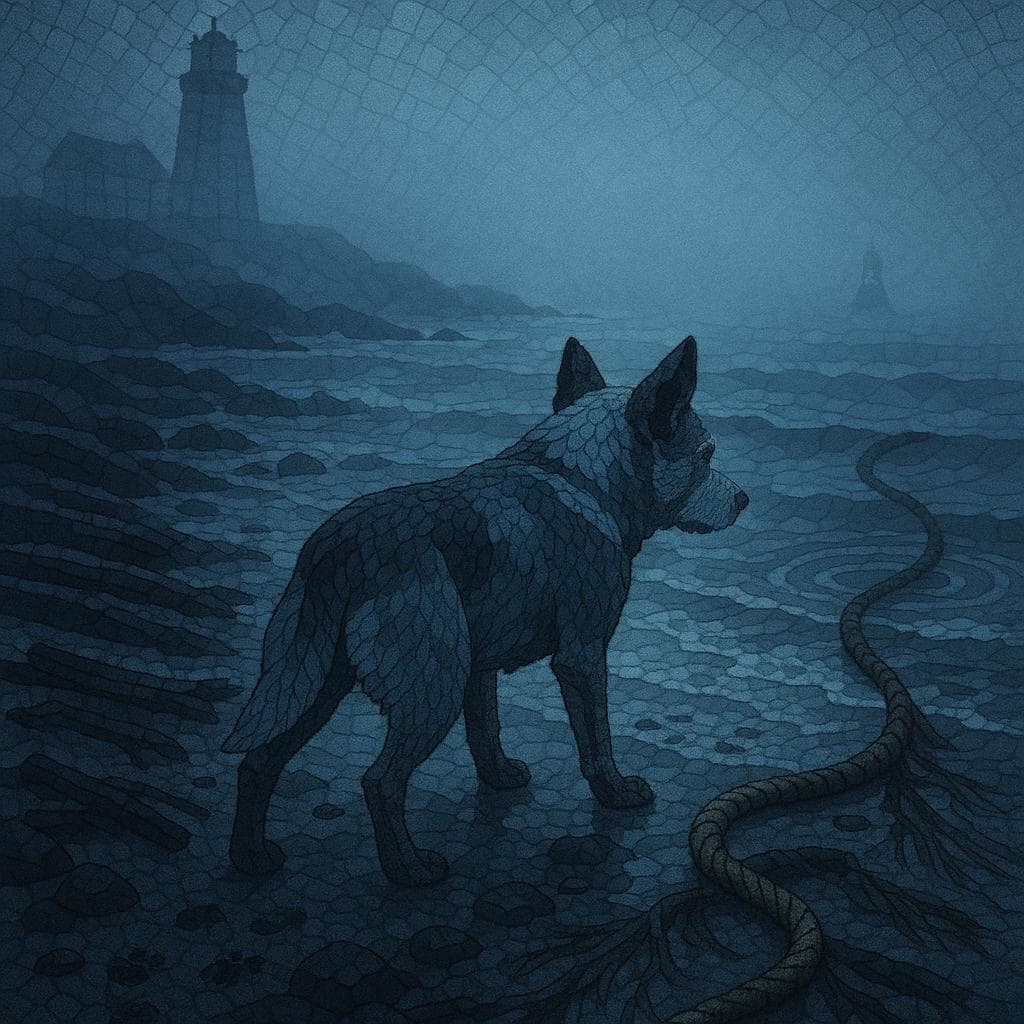
Night fog pressed inland as Faro, a fourteen year old Australian Stumpy Tail Cattle Dog, paced the empty shore. Salt and tar snagged his nose; the tide whispered secrets he almost remembered. The lighthouse stood dark, a black tooth. He paused, ears flicking at a faint bell no human would hear, coming from beyond the reef. Old bones ached, but the pull was older. He traced the scent ribbon to a half buried rope coiled like a snake, wet and shivering. Something tugged back. The fog throbbed. Faro growled, digging in. Rope tightened, and a pale hand broke the surface.
He braced, rope between his teeth, the fibers bitter with mildew and rust. Sand gave, then held; his shoulders burned. The water fussed and slapped, the bell out beyond the reef answering itself. The hand rose again, slender and rigid as driftwood, then an arm, then a face slick with kelp and pale as moon milk. Eyes opened, the color of beach glass. They did not blink.
Faro backed up until his hips trembled. The rope jumped with another pull from below, then loosened. The figure came with the sucking tide, the sea reluctant to give it back. A coat surfaced next, heavy oilskin, buttons tarnished to green, the old kind that smelled of lamp smoke and whale fat. A hat bumped the rocks and rolled. Faro caught a whiff under the salt stink—lanolin, old iron, the faint ghost of biscuits gone stale. Memory struck like a paw on his ribs. A whistle from a high porch. A boot scraping flint on a cold morning. He had come to that whistle once, all legs and impatience.
The man—if man was what he still was—found his feet on the tide line. Water washed off him and did not sink into him. He was as wet as weather itself. He looked down at Faro, at the chewed rope, at the prints in the wet sand that filled even as they were made. When his hand came to rest on Faro’s skull, it was as cold as a stone that never saw sun. Faro’s ears folded under the weight of it. He did not flinch.
The bell out beyond the reef tolled twice, not with wind but with intention. The man lifted his head toward the black tooth on the point. The lighthouse watched them both with its dead eye.
Faro nosed the man’s calf and stepped away, then looked back. His own body answered before thought: up the track, through the pepperbush and ice plant, his joints objecting to the climb and the damp. The man followed, oilskin whispering, boots leaving no print. Fog climbed with them, pressing from the sea, curling through the lantana, cuddling around Faro’s legs like an old cat.
At the base of the tower the door hung crooked, one hinge long gone to iron bloom. Faro pushed with his shoulder and the wood sighed open, admitting the smell of guano and dust and something sweetly rancid that shook loose an old ache in him, a grief he had paced around and around and never put his teeth on. The spiral stairs rose in a narrow twist. Faro’s nails clicked on the iron with every cautious step. The man came behind, not out of breath, not in any hurry that had to do with air.
At the room where glass had once made a diamond of the sky, the lantern sat like a belly gone hollow. Its reflected pieces caught a hint of Faro’s silhouette and flung it to the fog. Spider webs asked for rent from every corner. The wick was a black rope in a dry throat. Faro stood, sides pumping, chest hot and raw, tongue hanging. He could smell old oil in the wood, soaked through years of nights, years of weather. He could smell his own puppyhood running underfoot, a thump of boots, a laugh, a ham bone.
The man moved around the lantern the way one skirts an animal asleep. He put his hand to the windows, to the glass prisms stacked like a cut onion. When he wiped the pane with his sleeve, it left a smear and a shimmer. He crouched at the base of the lantern and ran a palm over the brass fitting. The bell sounded again beyond the reef: once, then once more, then a long third time, like a request grown urgent.
Faro nosed at a cabinet door swollen shut. He whined, a thin thread of sound. The man’s head turned. Faro clattered a paw against the wood and the door gave, a soft give, then a gradual groan. Inside, in the stale dark, sat a tin labeled in curling letters and a rectangle of fire-starting rags—the old names still there, paint scuffed but legible. Faro scraped until the tin rolled out, tasting of varnish and ghosts. The man knelt and worried the cap with a persistence that brought it. When the lid came off, a smell unrolled that was all the nights of Faro’s first winters.
The wick drank and fattened. The man’s hand vanished into his coat and came back with a little book of paper tabs. They were useless, their heads gray, their promise slept out. He did not swear. He looked at Faro as if a sound might split the fog wrong. Then he leaned his cheek toward the wick, the way a man greets a dog he trusts, and breathed. Faro smelled not breath but something like the sea before a squall, like ozone blooming blue in the mouth. The black rope took the whisper and orange crawled along it like a small animal finding its way home.
Light gathered itself. The first flare was no larger than a moth. It widened against the glass, found the lens, found the angles carved for it a century ago, found the stair of air up and up. The beam stepped out into fog and came back to itself stubborn as a working dog. It tracked slow and unblinking. When it passed over Faro, it left warmth on his scarred shoulder.
Out beyond the reef the bell did not ring. Water shifted and showed a line of white where teeth had been hiding. Something far off answered with a horn softened by miles. Faro tasted the change. The tide’s whisper lost its other words and became the one he understood: go in, go out, live, live again.
The man stood with his hand on the metal that had been his friend. He grew with the light until the coat had color and the skin was less milk. Faro recognized, not the face—death bleaches faces until they resemble each other—but the way he held his head, the tilt that said I hear it too. Hears you, boy, the whistle without whistle. Faro pressed his chest against the man’s shin with a small sound he had not made in years.
The beam made a revolution. Then another. The third caught the cliff line, the broken fence, the leaning shed where swallows braided summer air. Fog rolled back a little, offended. On the beach below, the rope lay quiet as if it had always been a sun-baked snake.
They did not linger. The light would do its work or it would not. Faro made for the stairs for the same reason he had climbed: because it seemed necessary. Halfway down his front legs buckled and he had to stop, head low, breath heaving. The ache was meat-deep now. The copper taste in his mouth was not copper. The man waited, one step above, hand hovering like weather waits without hitting.
Down on the stones the tide had turned. The first star of dawn fidgeted in the thinning fog. The lighthouse’s pulse swung and swung and then went pale as day found it. Faro took the track slow. He did not look back. The bell, when it came again, was small and far, a toy left under a couch.
He found the place where the sand was packed by last night’s tide, where the rope had dragged a trench toward the micaceous sheen of the wash. He stood in it, legs braced as before. The sea was ordinary now, smelling of kelp and diesel and the brittle tin of dawn. A gull came down and barked at him for being old. He barked back, one rough sound that emptied and settled something in his chest.
It was time to go home, and yet home had shifted. The porch with its cracked paint and water bowl, the hands that would scratch his muzzle and say his name twice—their faces blurred behind the fog for a moment. He could return, he knew he could. He could curl under the table, dream of cattle and fences, shiver when thunder rolled. But there was weight in his haunches that said this was the last time he would taste the tide.
The man came up beside him and crouched. He had gathered warmth back; his shadow lay real and soft on the sand. He put his hand again on Faro’s head and this time it was not cold. He smelled like lamp and wool and a winter morning forty tides gone. Faro leaned into him and the lean slid into a sit and the sit poured into a lay without embarrassment. He put his chin on the man’s boot and let the sea speak over their shoulders.
They stayed that way until the first clean line of sun pushed the fog toward the hills. The lighthouse on the point quit being a tooth and became a blunt finger pointing nowhere dangerous. The beam went out not with drama but with the fatigue of any night ending. Faro’s lids felt heavier than storm clouds and twice as soft. He closed them to slits and then to nothing.
He could feel the sand’s cool under his ribs. He could hear, through skin and bone, the bell’s last note fold into the deep. Somewhere above him gulls started their quarrels. Somewhere behind him, a door would open and a voice would call his name that meant food, work, love, and all of them at once. He would answer or he would not. He thought of the rope. He thought of the first whistle and the first bone and the hard palm that had taught him not to chase the cat who came anyway.
The hand on his head lifted as if to let him choose. Faro’s breath went out and paused. He let the sea fill the pause with its unending in, out, in. He had done what the old pull asked. He had brought the dark back to light just once more. He had been a good dog. It was enough.
When the sun had cleared the horizon, the beach was only a beach again, with footprints and a bit of rope and a hat rolling in the wash. The bell beyond the reef was silent. The lighthouse stood ordinary and blind. The track up the hill held two lines of prints and one trail where fur had dragged like a brush through damp paint. The day went on because days do. And somewhere, where the fog begins, someone whistled, and something young and eager lifted its head and ran.