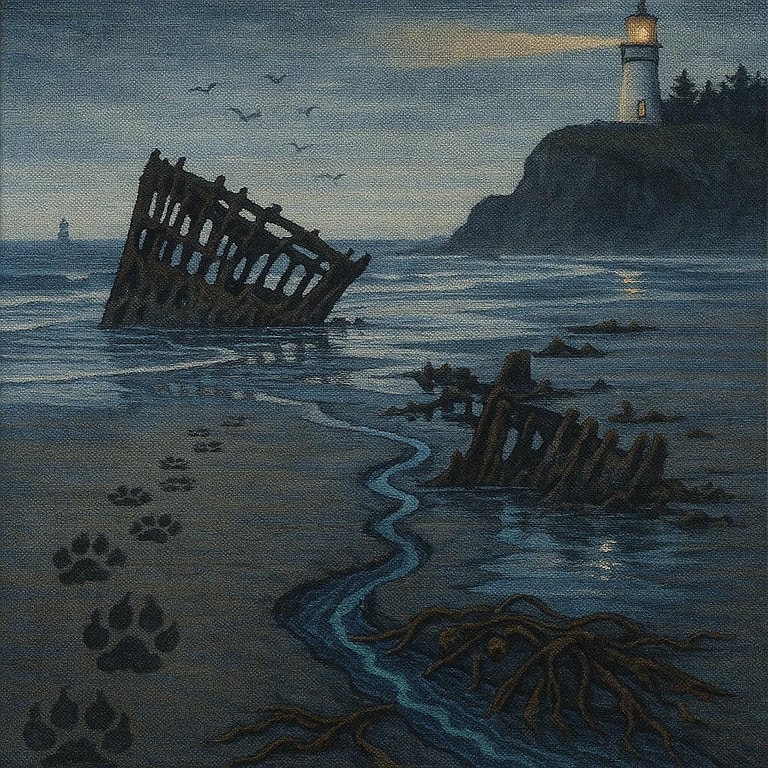
The Stone That Remembered

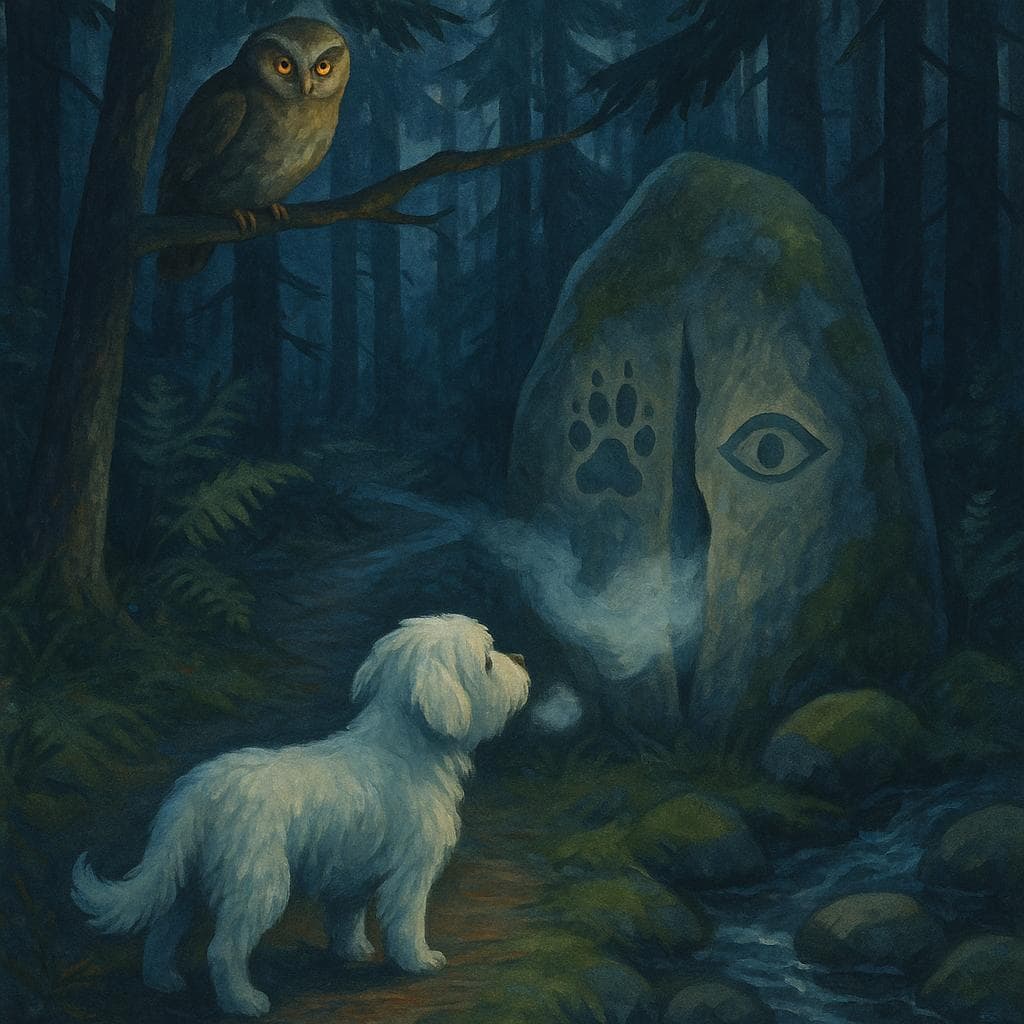
Moonlight threaded the pines as Frost, a fourteen-year-old Maltese, moved with careful grace. He felt his hips ache, yet he welcomed the hush, for the forest kept secrets and he had come to ask for one. Owls watched, amused, knowing he had walked these paths in younger days. The creek spoke in riddles. Frost paused where moss veiled a stone carved with a paw and an eye. He remembered the legend, and the legend remembered him. From the dark behind the stone came a breath, and then the stone slid aside.
Cool air rolled out of the opening, rich with root and stone, the kind of dark that remembers rain even in dry years. Frost set one paw on the threshold, then another. The moss bent and sprang back as if greeting an old friend.
Inside, the passage was not entirely a tunnel and not entirely a den. The walls were wood and earth, braided with pale threads that glowed when his whiskers brushed them. Somewhere water ticked, counting the heartbeats of the hill. He moved slowly, not from fear, but because slow was a kind of respect now.
The breath came again, farther in. It smelled of mouse and oak and the first snow he had ever tasted when he was nothing but a white tumble in a blue scarf, the hands around him new and unsure and trying not to cry. He remembered how he had licked the salt from those hands, and how the world had decided after that to be kind to him whenever it could.
A shape waited at the end of the passage—bigger than any dog, big as the idea of a dog before there were any. It was not a wolf, though it wore that suggestion. Lichen hung from its shoulders as if it had stood still long enough for seasons to draft their own stories on its hide. Eyes the color of creek-glass and owls stared from its face. Between its paws lay a shallow depression in the earth, smooth as if a thousand small hearts had pressed there and left their patience behind.
“You remember me,” Frost said, and though his mouth never moved that way in the world of kitchens and carpets, here the thought went out true and was understood.
“I remember you,” said the forest in the body of the old thing. “You wore your name like winter wears silence.”
“We made a bargain once,” Frost said. It wasn’t a sentence so much as the lift of his gaze and the way his tail made one small, polite circle. He remembered a younger night, a squirrel that did not get away, a whistle at the edge of hearing, and his own choice to turn back from a chase because there had been a promise made. He had come again for something you only asked for once.
“What do you want?” asked the room of earth, though it already knew. That was the courtesy of old powers: letting you say it.
“A path,” Frost said. He did not say older words for ending because dogs are not burdened with them. He thought of the bed where the woman he had raised was sleeping with her hair over her face. He thought of how stairs had become steeper and how lately the sun liked to set in his bones. “Not long. Just right.”
“Paths take something,” the old thing said. “Doors cost doorways. Would you leave a thing here?”
Frost considered. He had already given pieces of himself away, as life demanded: toys to teeth, fur to couches, pride to funny sweaters and holiday bows. He had kept three things as private: his name, his shadow, his bark. Names mattered and shadows were useful when it was hot. The bark was trouble. He had used it to scare off thunder once, and sometimes mail, and to say “I am still watching” when the house was too quiet. He could let that go. If the last stretch of his trail needed silence, he could give it the gift.
“My bark,” he said, and laid it down into the smooth bowl of earth. It left him without ceremony—a low note, a paw’s worth of sound, a little click in the dark like claws on tile. The depression held it. The air softened.
“So be it,” said the forest, gentler now. “Run with me.”
Pain left first, like a coat shrugging off. His hips forgot their argument. Frost stepped forward and found the passage widening into a slope. He ran.
He ran in a body that was still his and also every dog he had ever been—a puppy skidding on kitchen linoleum, a bold teenager with snow on his muzzle, a dignified sentinel counting the cars come and gone, a napping old lord of sun patches. The old thing ran with him not ahead but alongside, sometimes a shadow, sometimes a breeze, sometimes nothing but the comfort of an unbroken path.
They went past roots like ribs and out into the underside of the forest. The pines were columns. The moon was lower than he had ever seen her, a silver coin between his teeth. Owls slid from branch to branch, not hooting, just watching him pass. The creek forgot its riddles and simply laughed.
He chased smells that had already happened: the first day he had found the girl crying into the porch swing, the time she had hidden a meatball in her pocket for him and pretended not to, the night they had both been afraid of wind and he had put his head on her knee and learned that it was possible to be brave for two. When he leapt a deadfall log he landed in last summer, brittle and sweet. When he ducked under a fern he came out of the groomer’s place into a bright noon. He had never been able to read the clock. Now he didn’t need to.
At a clearing, the ground dipped to regular dirt again, the kind that takes a good pawprint and holds it as long as dew. The old thing slowed. Frost slowed with it. He could feel the ache waiting for him where he had left it, patient as a good blanket.
“Here is your path,” the old thing said, and the words were also the line of trees that showed a direction and the way the wind moved and the listening he had done all his life. “It goes home. It goes past home. It comes back when it can.”
Frost stood very still. Breath in, breath out. He thought of the shoe by the back door that smelled like all their summers. He thought of the bowl with a chip on the rim and the worn spot in the rug where the sun liked to sleep. He thought of the time the child had been fever-hot and he had stayed and stayed and stayed.
“Will it frighten her?” he asked, and his ears lowered just a little.
“She will be sad,” the forest said, with no lie in it, “but she will not be alone. We keep what is left, and the rest of you simple ones learn the trick of being in two places at once.”
He believed it, because he had always believed the important things. He nosed the old thing’s paw, a thanks given from nose to earth. The lichen shook and smelled like rain a day early.
“Go on,” said the night.
He came out from under the hill with dawn just thinking about it. The stone had slid back into place. The paw and the eye on it looked exactly as they had, which is how it is with old agreements; the world keeps a straight face. The creek gave him a quiet sentence that might have been his name and might have been “hurry.”
The path took him true. He trotted without a bark to spare and did not need one. The house was there, the porch, the patched screen, the places where he had argued with delivery trucks and won. He nudged the door with his head. It gave. He was allowed everything he had ever needed to be allowed.
Inside, the air held the hush of sleeping and something like the fresh peel of an apple. He moved through it, not creaking a floorboard, because tonight he could be light. He found her where she had always been most herself: sprawled and soft and a mess of hair and blankets, one hand open, palm up. He put his chin there and then lowered his head to the old shoe by the bed, because ritual matters.
He did not think “now.” He simply let the path under him turn from wood to something else. His breath went out. It did not need to come back. What left him was the part of warmth that remembers who it is.
It was not dramatic. It did not hurt. It was correct. The kind of ending that feels like brushing a burr out of tails and finding the fur smooth again.
In the morning she found him. There was the cry, and then there was the quiet after it, and then there were hands that had learned long ago to be kind to him. She tucked his ears the way he liked. She told him all the true things: that he had been good, that he had done his job, that she would take it from here. The owls in the trees did not comment. The creek had nothing clever left to say.
The forest kept its secret. It kept his bark in a bowl in the dark and let the deer borrow it when they needed to startle foxes, and sometimes in winter you could hear a sound far off that was not thunder or mail but the memory of a small voice being brave.
As for Frost, he did not fail at being a dog just because he had run on. He learned the trick of two places. On cold mornings a bit of fog would settle low in the yard and then lift as she opened the door, and it would move with purpose, and if you watched it for just a breath you could mistake it for a white tail going ahead down the path.
He was not gone. He had simply run ahead.