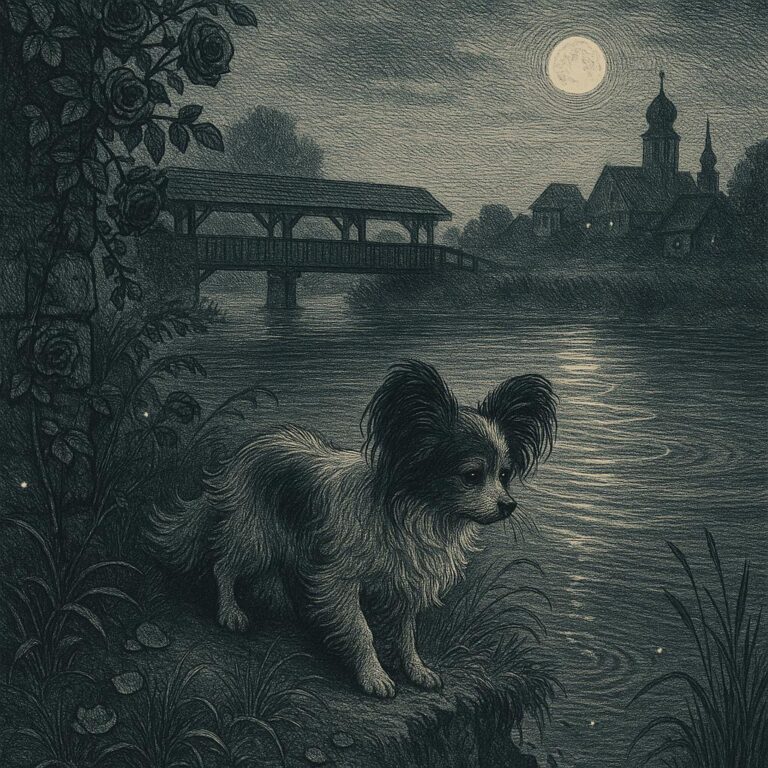
The Red Boot at the Bend


Paddling is beneath my dignity at fifteen, but I, Gus the German Shepherd, patrol the riverbank like a retired lifeguard with opinions. My human tosses a squeaky trout; I offer commentary and a dignified shake. The river tells jokes in bubbles. I sniff reeds, eavesdropping on otter gossip, when the current yanks the trout, spins it toward the bend, and something else bobs after it: a tiny red boot. My herding heart kicks in. I launch, paws skidding, collar jingling, teeth set for glory, but the bank crumbles beneath me and, as I plunge, a dark shape surges up.
Water grabs me in a cold, rude hug. The river is louder down here, all glugged jokes and the hiss of sand. The dark shape surges again and bumps my shoulder—slick, whiskery, the exact condition of gossip made flesh. Otter. Two, actually, peeking with mustard-seed eyes, unafraid of my old-lifeguard bulk. One slaps its tail and shows me teeth like bright seeds, then arrows toward the boot as if auditioning for my job.
My hips complain that paddling is beneath them, too. They can lodge a protest form later. I hack through the chop, head high, tail doing its best impression of a rudder with opinions. The squeaky trout floats ragdoll near the boot, letting out a muffled eeek when the current pinches it. The red boot tumbles heel over toe, light, not a child, not a weight. Good. Good. But my nose hooks something thinner and important—milk-salt, little human panic, a thread of it upstream, wind-shredded.
My eyes find it: the willow bend snatching at a small shape, a pale face flowered among leaves. A tiny hand with starfish fingers and one bare foot clawed against a root. The boot’s twin. The boot I almost claimed as my hero prize.
I change course so hard my back hollers. The otter veers with me, a slick comma in my sentence. She chatters at me in fast river talk as if we’ve been coworkers for years. I let the boot go; it spins away, the trout follows, squeak-squeak like a metronome counting down something I don’t intend to miss.
“Gus!” my human calls, a broken stick of sound behind me. There’s another voice, thinner, the tinny clatter of fear that tries to be a name.
I reach the willow. The child has gotten quiet, which alarms every shepherd molecule in me. Quiet is not the business of creatures who should wail. The current pulls her sideways, insists. I put my chest against it. I give the river my old soldier stare. It doesn’t care, of course, but I do, and I am heavier than my years when I decide to be.
“Hi,” I say without words, pushing my neck under her hand. She flails, then grabs my ruff as if she is born to it. I sink an inch with her weight and rise coughing, nostrils flaring river, fur pulling like Velcro. I am a barge. I am a pontoon amendment. My feet find the underwater stones one at a time, careful as a librarian shelving books. The otter body-checks my flank, then darts to the side and mocks the current with small, arrogant S-turns. Show-off.
We angle toward the gravel bar I know holds my human’s footprints and sun-warmed smell. I don’t let the child’s grip slide. Her breath comes in little hiccup flowers against my ear. I keep my head tossed high, keep her out of the river’s busy mouth. The willow combs my back. My hip gives a begrudging click. The trout squeaks, somewhere, idiotically cheerful.
There is a moment where the current leans its shoulder into us and I feel my age like weights tied to my ankles. My back leg slips. The river ribs me with a root and tries to steal the child off my neck. For a heartbeat I see my first day at the big lake, a thousand years ago, a tennis ball turning into a sun, me learning what my legs are for. I haul up that day and put it under me. I plant my paws wide and shovel water. The otter flashes past my nose like punctuation. I get us into the slower belly of the bend.
Then hands—grown hands—are in the water, my human’s, a stranger’s, strong and shaking. The stranger smells like wool and rain and the trampled flowers of fear. She wades until the river decides it’s had enough of her rib cage, takes the child from me with an apology to my fur, says a name over and over into wet hair.
They stumble to the gravel bar. I walk out stiffly, everything about me suddenly very heavy except my tail, which is making its own small weather system. The humans make noises the river hasn’t heard in a while, soft-sobbing thunder, thank yous tossed like pebbles that keep plopping because they can’t stop. My human’s hands find my ears, my collar, my whole waterlogged self, and arrange praise along me like a blanket.
The otters surface to see if I will dare claim their overtime, chittering the way creatures laugh when they’ve been useful and want you to notice without staring. They push something in on the skim—my trout, of course, riding dignified as if it had sat out the rescue with crossed fins. Behind it, bobbing red like a berry, comes the boot.
I nose the trout into my human’s shins and pick up the boot instead. Rubber tastes like toy and mud and a little-salted child. The child reaches with her arms burritoed in towel, still hiccuping, and grabs for it with the needy precision of someone who has just remembered that she owns one foot’s worth of pluck. I set the boot in her lap and she holds it like a rescued pup until her mother guides it where it belongs. A bare foot disappears. The world clicks shut in that small way it does when the missing piece finally sits.
We all stand there steaming in the thin sun. My human takes off his shirt and rubs my coat until I’m a storm cloud shedding rain in rivulets. He narrates my excellence into my ear, uses words like hero as if they fit under my collar. I lean heavily against his legs because he is mine and the earth moves less when I touch him. If we were a pack of wolves we would nose the child and carry her a rabbit and the river would pretend not to look. We are not, so we handle it with towels and boots and trembling.
The strangers do that human thing where they want to press their mouths to my head and I permit one of them, because she is the child’s sun and her mouth tastes like gratitude and river and the bottom of a tea mug. She says my name wrong on purpose, stretching it like taffy: Goooooose. Close enough. Geese are also heroic, probably. The child peers at me from the towel cave as if I am a new kind of big star. She reaches out a damp finger and touches my nose. It squeaks. Or maybe that’s just the trout under my paw, because I realize I have stepped on it.
The otters flip a last silver laugh and vanish, their gossip taken to the next bend. The river settles back into its routine of bubble jokes and minor thefts. It has my smell now, in it the way smoke lives in blankets. It will tell a story about me to the cattails later and they will shake their heads and lie that they knew it would happen.
We walk the long way back, because my legs insist, because every step on stone tells me I still belong where the world moves. My human throws the trout once, easy, along the margin where the water is tame, and I let it plop. He knows. He doesn’t press. We find the path with the burrs and the secret grass that remembers snow. My fur does its broom thing. My collar clinks like a small bell calling cows to chapel.
At the car, he lifts me at the hips with the harness he bought when the stairs began to argue with me. I pretend not to notice the gentleness of it. He tucks a towel around me like a burrito and drives with one hand on my shoulder, which is exactly my idea of a commute. The child and her mother keep waving in the rearview until the bend takes them away.
At home, the porch boards aren’t sure about my dampness, but they get over it. My bed smells like yesterday’s sun. I turn three times because turning once is for casual acquaintances, twice is for cats, and three means I intend to dream.
Before I go under, my human kneels and presses his forehead to mine in that way he learned from me. “Old man,” he says, voice full of lake and pride. I blink at him with the river still moving in my eyes. I could tell him things about the way the current holds a secret under every leaf, about otters having better jokes than dragonflies, about how a red boot is not always a toy. He scratches the point where my ear meets my skull and I let him take it as the same.
Paddling is beneath my dignity. But some shifts you don’t clock out of, even at fifteen. The river is half asleep by now, telling last-call stories to the ditch. I put my chin on my paws. In the quiet, something squeaks, very far away and very pleased with itself.
I let it. I’ve earned the laugh.